

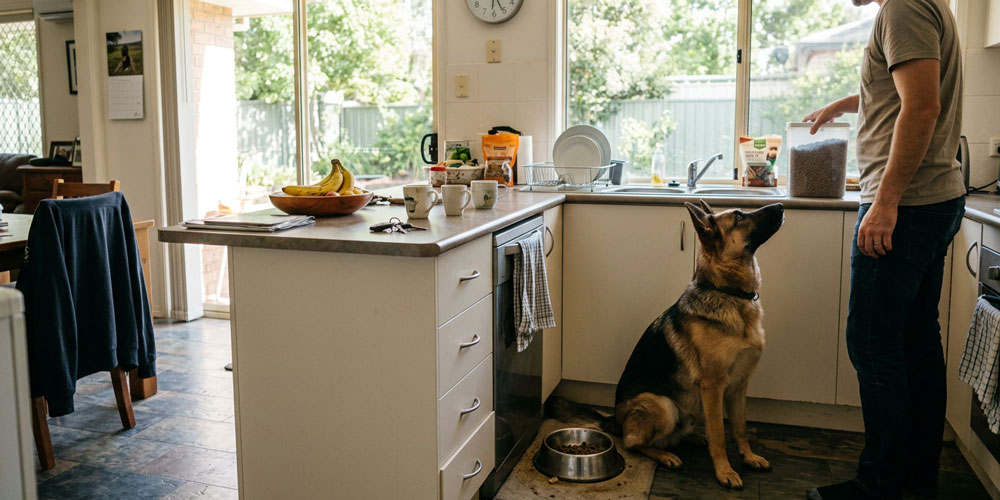
It's 5:27 pm. You haven't looked at the clock, but your dog is already sitting beside their food bowl, staring at you like you've forgotten something extremely important.
Three minutes later, they're following you into the kitchen. By 5:30 pm, they're convinced dinner is officially late.
Sound familiar?
Some dogs seem to know their feeding schedule better than their owners do. But here's the interesting question: can dogs actually tell what time it is, or have they just become incredibly good at predicting our behaviour?
The answer is a little bit of both, and the science behind it is surprisingly fascinating.
Dogs Don't Need a Clock to Recognise Time
Your dog probably isn't lying on the couch thinking, "Excellent, only 17 minutes until dinner."
But that doesn't mean they have no sense of time.
Like humans, dogs have an internal biological clock that helps regulate their sleep, activity and other daily patterns. This is known as their circadian rhythm, and it responds to cues such as daylight and regular daily activities.
Dogs can also learn when certain events usually happen. If dinner arrives at roughly the same time every evening, they may begin anticipating it before you've even reached for the food.
So while there's no evidence that dogs understand clock time the way we do, they can certainly recognise patterns associated with different parts of the day.
Your Dog Might Be Watching You More Closely Than You Think
Here's where things get interesting.
Your dog doesn't necessarily need to know it's 5:30 pm. They just need to recognise what usually happens before 5:30 pm.
Maybe you finish working, close your laptop and walk into the kitchen. Perhaps you switch on the lights, put your bag down or start preparing your own dinner.
To you, these are ordinary everyday actions. To your dog, they could be signals that something exciting is about to happen.
Dogs are excellent at learning associations. If a particular sound, movement or routine repeatedly happens before food appears, they can learn to anticipate what comes next.
That's why your dog might suddenly appear when you open a particular cupboard, even if they were fast asleep seconds earlier.
It's not magic. They've been paying attention.
Could Their Sense of Smell Help Them Tell Time?
You've probably heard that dogs experience the world through their noses. But could smell also help them recognise when something is about to happen?
It's an intriguing possibility.
Scents change throughout the day as people move around, food is prepared and the environment changes. Researchers have explored how dogs use odour information to understand their surroundings, and some theories suggest changing scent patterns may provide clues about elapsed time.
However, there isn't strong evidence that dogs use fading household scents to calculate when dinner is due.
It's a fascinating idea, but their ability to learn daily routines is a much better-established explanation for those perfectly timed dinner demands.
Why Does Your Dog Start Asking for Dinner Early?
Here's something many dog owners will recognise.
Dinner is normally at 6 pm. But one afternoon, your dog starts staring at you at 5:15 pm. The next day, they're waiting at 5 pm.
Have they somehow forgotten the schedule?
Not necessarily.
Dogs learn which behaviours get results. If sitting beside you, whining or nudging your hand occasionally convinces you to serve dinner earlier, they may try those behaviours again.
And if you've ever given in because the staring became unbearable, you may have accidentally taught them a very effective strategy.
Food anticipation can also be influenced by activity levels, excitement, changes in routine and individual appetite.
The important thing is to distinguish normal enthusiasm from a genuine change in hunger. If your dog suddenly seems constantly hungry, is losing weight or shows other unusual symptoms, speak with your veterinarian.
Do Dogs Prefer Eating at the Same Time Every Day?
Many dogs benefit from a predictable feeding routine.
Regular meals can make daily life easier to manage, help owners monitor appetite and provide consistency for dogs who enjoy knowing what happens next.
But that doesn't mean dinner must arrive at exactly 5:30 pm every single day.
For most healthy adult dogs, a reasonably consistent routine is more useful than following the clock down to the minute. Puppies and dogs with certain medical conditions may need more specific feeding schedules.
If your dog becomes distressed whenever dinner is slightly late, gradually teaching them to settle calmly around mealtimes may help.
Try rewarding relaxed behaviour rather than responding immediately to barking, jumping or persistent demands.
Make Dinner More Exciting Without Giving Them More Food
Here's an idea your dog might appreciate: what if dinner wasn't just something they ate, but something they got to do?
Instead of serving every meal in a regular bowl, you can occasionally turn part of their usual food allowance into an enrichment activity.
For example:
- Slow feeders: Encourage dogs who gulp their food to eat at a slower pace.
- Puzzle feeders: Let dogs investigate and work out how to access their food.
- Snuffle mats: Encourage natural sniffing and searching behaviours.
- Stuffable toys: Turn part of dinner into an engaging activity that lasts longer than a few mouthfuls.
Interactive feeding toys such as the KONG Wobbler can make dry-food mealtimes more interactive, while KONG Classic toys can be filled with suitable food for supervised enrichment.
Start with an easy activity so your dog doesn't become frustrated. Choose products appropriate for their size and chewing habits, supervise use and include any food used in their daily allowance.
You don't need to add extra treats to make dinner more exciting. Sometimes, changing how food is offered is enough.
Try This Little Experiment With Your Dog
Want to find out whether your dog is responding to the clock or your routine?
For a few days, pay attention to what happens just before they start asking for dinner.
Do they appear when you close your laptop? When someone arrives home? When you walk towards the kitchen?
Then, on a suitable day, change one harmless part of your routine without significantly changing their feeding schedule.
For example, try finishing work in a different room or preparing your own meal at a different time.
Does your dog still start waiting at their usual time, or do they react more strongly to your familiar movements?
It won't scientifically prove how your dog experiences time, but it can reveal some of the everyday signals they've learned to recognise.
And you might discover that your dog has been studying your habits much more closely than you realised.
Summary
So, does your dog actually know when it's dinner time?
In their own way, yes! Dogs have internal biological rhythms and can learn remarkably accurate daily routines. They may not understand what 5:30 pm means, but they can recognise the patterns, sounds and activities that usually lead to dinner.
The next time your dog appears beside their bowl before you've even thought about feeding them, remember: they haven't necessarily learned to read a clock. They've learned to read you.
And when dinner finally arrives, a little enrichment can make their favourite part of the day even more rewarding.


